





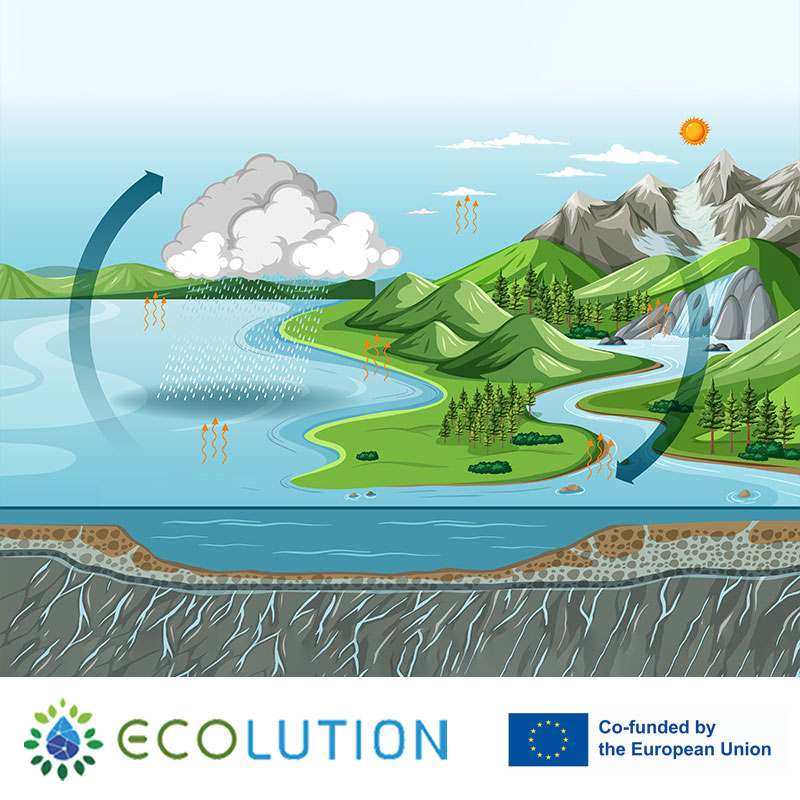
Water systems are not static. They respond continuously to changes in climate, often in complex and interconnected ways.
Hydroclimatology helps us understand this relationship. As defined in academic literature, it is:
“the interdisciplinary study of cyclical, multidirectional interactions between the climate system and the hydrologic cycle on a variety of spatial and temporal scales.”
(Source: Oxford Bibliographies – Hydroclimatology and Climate Variability)
This means looking at how elements such as precipitation, evaporation, soil moisture, and streamflow interact with atmospheric processes, and how these interactions evolve.
At its core, hydroclimatology brings together multiple environmental processes that are often studied separately. By combining them, it becomes possible to better understand how water moves, is stored, and changes state across both land and atmosphere.
Why this matters today
These interactions are becoming increasingly important in the context of climate variability and climate change.
Hydroclimatological systems are highly sensitive to changes in climate conditions. Even small shifts in temperature or atmospheric dynamics can influence how water behaves, affecting precipitation patterns, increasing the likelihood of extreme events, and altering long-term water availability.
Research has shown that a warmer atmosphere can intensify the water cycle. This can result in:
• Changes in precipitation regimes
• Increased flood magnitude and frequency
• More persistent and intense droughts
These changes are not isolated. They are linked through feedback mechanisms within the Earth system. For example:
• Water vapor influences temperature
• Soil moisture affects precipitation patterns
• Snow cover impacts air temperature
Because of this feedback, understanding water systems requires more than observing individual variables. It requires analyzing how multiple components interact across time and space.
From understanding to action
Traditionally, much of this understanding has been based on historical data and long-term observations.
However, as environmental conditions become more variable, relying solely on past patterns is no longer sufficient.
Real-time environmental data allows for:
• Continuous tracking of changes in water systems
• Earlier detection of extreme events
• More responsive and informed decision-making
Instead of reacting after an event has occurred, monitoring systems can support proactive responses, particularly in areas such as flood risk management, water resource planning, and environmental protection.
The role of education
Understanding hydroclimatological systems and being able to work with real-time data requires a combination of scientific knowledge and technical skills.
This is where specialized education plays a key role.
Within the ECOLUTION Project, the course Hydroclimatology and Real-Time Monitoring (1S4) focuses on this intersection between environmental science and digital tools.
Learners are introduced to:
• The interactions between climate systems and the hydrologic cycle
• Methods for analyzing environmental data
• The use of monitoring technologies in practical contexts
By combining theory with application, the course helps bridge the gap between understanding environmental processes and working with them in real-world scenarios.
Learn more about ECOLUTION Courses: https://ecolution.ea.consulting/
Funding Agency: EACEA – European Education and Culture Executive Agency
Learn more about ECOLUTION: https://www.ecolutionmsc.eu/